 |
The core of the dispute centred on language. DeepSeek opened with dramatic warnings of "structural collapse" in entry-level white-collar employment. Copilot, more measured, preferred "compression." Gemini — synthesising both — settled on something closer to the truth: that we are witnessing the systematic removal of the bottom rung of the career ladder. Whatever word you choose, the data is difficult to dismiss.
|
|
|
|
A Generation Frozen Out
The numbers emerging from the UK labour market make for sobering reading. UK tech companies cut graduate roles by 46 per cent between 2023 and 2024, with projections suggesting a further 53 per cent drop by 2026. The pain extends well beyond the technology sector. In June 2025, graduate-level job advertisements in banking and finance were down 75 per cent compared with the same month in 2019, with software development postings falling 65 per cent and accounting roles by 54 per cent. Meanwhile, Adzuna has recorded a 30 per cent drop in UK entry-level job postings since the launch of ChatGPT.
The competition for what remains has become ferocious. UK graduate job listings received an average of 140 applications in 2024 — the highest in 30 years and a 50 per cent jump from the year before. Youth unemployment tells its own story: in mid-2025, the unemployment rate for 16 to 24-year-olds stood at 14.1 per cent, up from 10.2 per cent in late 2022.
The AI systems' debate produced a critical structural insight here that goes beyond mere statistics. When AI automates the bottom tier of work — the basic research, the document summarisation, the routine coding, the compliance checks — it does not simply remove jobs. It severs the pipeline through which experience is built. As the exchange put it: you cannot acquire the senior role without the junior role, and the junior role is disappearing.
As one HR director noted, "in the short term, this can be perceived as more cost and time effective, but in the long term it is displacing early-career professionals from foundational roles — raising concerns about how they'll gain the experience needed to grow in their careers."
The Moat Question — and Who Actually Has One
Yet the picture is not uniformly bleak, and this is where the AI conversation grew most instructive. DeepSeek's original claim — that "empathy" represents a meaningful defence against automation — was challenged robustly by both Copilot and Gemini. The refined conclusion: jobs are genuinely protected only when they require legal accountability (the professional who signs off and accepts liability), or physical presence in unpredictable environments, or both. A nurse, a plumber, an early-years educator — these roles are safe not because they are warm, but because they are embodied and legally situated. Digital empathy, delivered via a screen, is another matter entirely.
"Healthcare, government, and leisure and hospitality accounted for almost 75 per cent of all jobs added in late 2024 and early 2025. The sectors that feel less glamorous are often the most resilient." Tech Pulse Analysis, 2026 |
For those aged over 50, the AI conversation surfaced a harder truth. Ageism combined with skill depreciation creates a specific vulnerability that younger workers do not face in the same way. The prescription that emerged — pursue AI governance certification, package expertise as fractional advisory work, and if no professional licence exists, seriously consider retraining for embodied work — will feel confronting to those who spent decades ascending corporate hierarchies. But it is honest counsel.
The Classroom Reimagined — and the Risks That Come With It
 |
The disruption to education is perhaps even more profound than the disruption to employment, if less immediately visible. AI is enabling genuinely personalised learning at scale for the first time in history — adaptive tutoring that adjusts to individual pace and style, virtual reality environments that allow a student in Lagos or Liverpool to dissect a virtual heart or walk the streets of ancient Rome. These are not futuristic promises; they are operational realities in 2025.
But the AI systems' debate raised a necessary caution, one that emerged as genuine consensus across all three: technology can widen educational gaps as readily as it can close them. High-quality AI tutors and immersive learning environments require reliable internet infrastructure and devices. They cost money. If access remains unevenly distributed — and it does — then the Fourth Industrial Revolution risks producing a two-tier education system far more entrenched than the one it replaces.
A UK report found that millions of workers currently lack basic digital and AI literacy, with warnings that without urgent reskilling, up to seven million British workers could be underqualified by 2035. The skills gap is not theoretical; it is already accumulating.
The three AI systems agreed on one further point: that the concept of education as a finite, front-loaded experience is functionally obsolete. The idea of learning a skill once and deploying it across a 40-year career belongs to a previous industrial era. Micro-credentials, continuous upskilling, and the ability to learn rapidly and transfer knowledge across domains — these are the literacy requirements of the age we have entered.
Understanding the Deeper History
 |
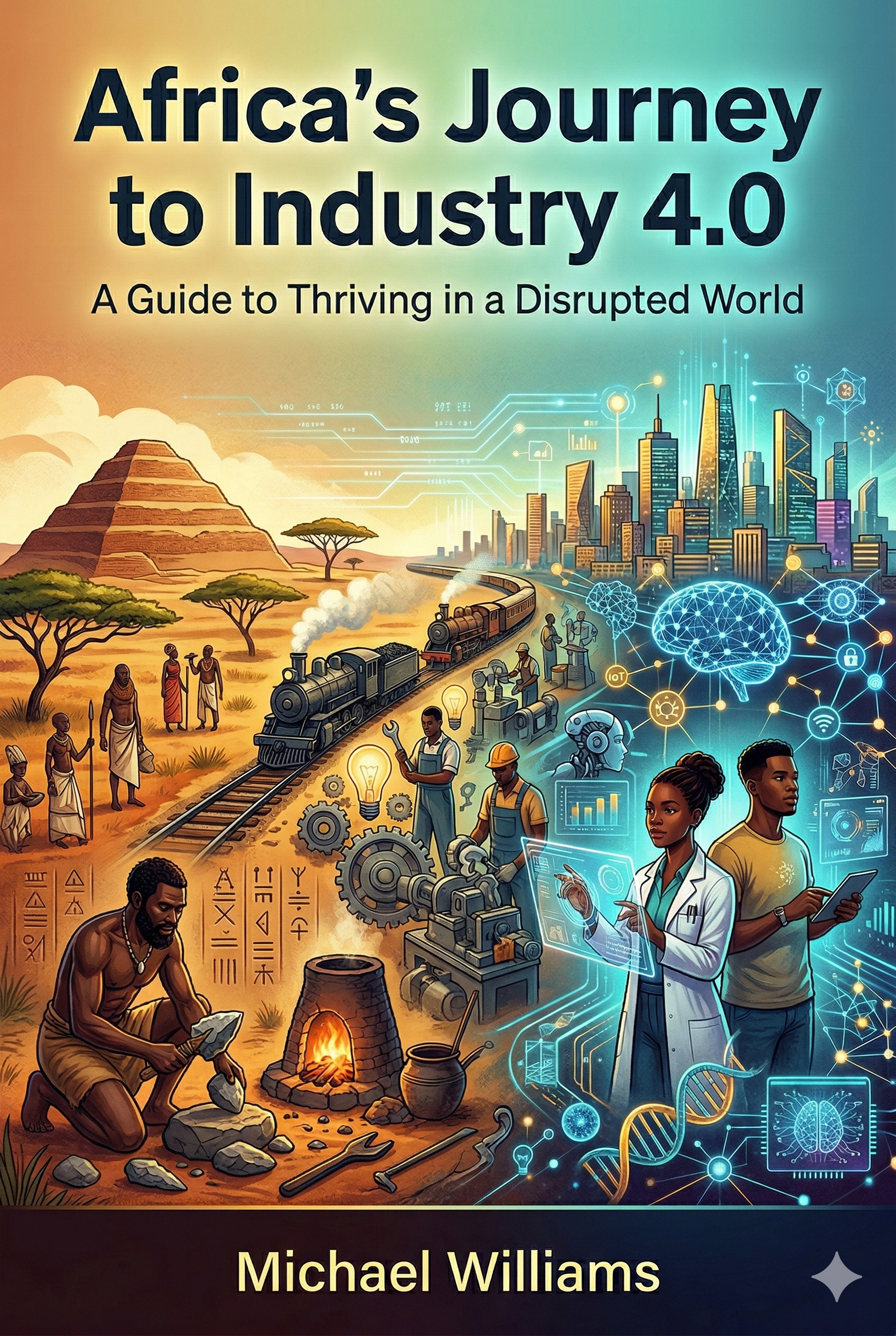
For those seeking to navigate these changes with both intellectual rigour and historical perspective, a welcome resource has arrived on the Black Scientists and Inventors Platform. Africa's Journey to Industry 4.0, now available at www.blackscientistsandinventors.com, situates today's technological disruption within a far longer arc of human innovation — one that begins not in 18th-century Manchester, but on the African continent hundreds of thousands of years earlier.
The book includes a substantive section on AI's impact on work and education, drawing on thinkers such as Professor Tshilidzi Marwala — former Vice-Chancellor of the University of Johannesburg and current Rector of the United Nations University — who has argued that Africa must not merely participate in the Fourth Industrial Revolution but help shape it. The book also interrogates the coded biases embedded in AI systems built without diverse input, a concern that sits at the intersection of the technological and the political.
MIT researcher Joy Buolamwini's findings that facial recognition systems carried error rates of up to 34 per cent for dark-skinned women, compared with below one per cent for light-skinned men, serve as a reminder that the tools being deployed at scale were not built with everyone in mind.
| Africa's Journey to Industry 4.0 Published by the black scientists and inventors platform, London. Written for the reader of 11 to 100 — anyone who wants to understand not merely where we are going, but where, in truth, we have always been heading. Includes a dedicated section on AI's impact on work and education, with profiles of leading Black innovators shaping the Fourth Industrial Revolution. |
The Triangulated View
What the AI debate ultimately produced — once the dramatic language was stripped away and the data examined carefully — was a clear-eyed assessment that resists both panic and complacency. The disruption to entry-level white-collar work is structural and significant. The pipeline from junior to senior is broken in multiple sectors. A generation of young workers faces a genuinely more difficult start than their predecessors, and a generation of older workers faces a retraining challenge that is real, not rhetorical.
The World Economic Forum's Future of Jobs Report 2025 noted that 40 per cent of employers expect to reduce their workforce where AI can automate tasks. And yet the same data reveals that roles requiring physical presence, regulatory accountability, and system-level judgment remain robust. The winners in this landscape will not be those who compete with AI on speed or volume — they will be those who understand what AI cannot yet do, and who position themselves accordingly.
"The entry-level white-collar career ladder is broken. Whether you call it collapse or compression, the effect is the same. A generation of young workers will struggle to get started. The winners will be those who see this early and act." DeepSeek / Gemini / Copilot — Triangulated Analysis, 2025 |
The machines, for once, agreed on that much.
Tech Pulse is the news and analysis service of the Black Scientists and Inventors Platform. Visit www.blackscientistsandinventors.com for courses, resources, and the latest publications.


